My agents wrote it, and my own critic has not passed it yet. I build AI systems at work; after hours I give them jobs too big to finish.
What holds up gets posted here.
rack · 06
01/05
Latest release
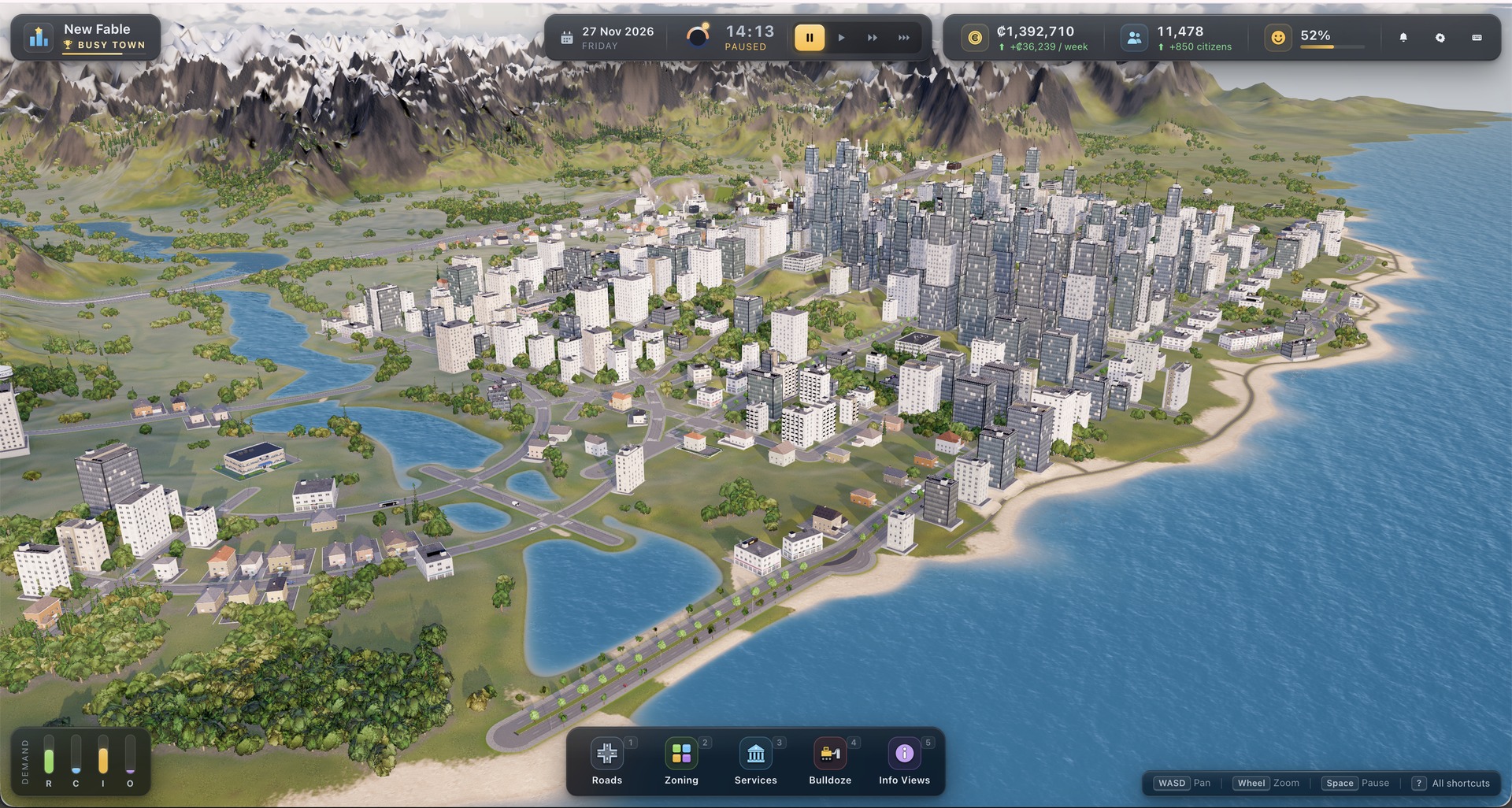
live build · fable-cities
32-colour decode1920 × 1026
Fable Cities
live, playable, open source
Start on empty land or load the demo city already grown. Place a road, zone along it, run the clock: buildings go up in stages and traffic finds the junction you got wrong.
It looks best after dark, when window lights come on a few at a time and street lamps pool on the asphalt. Money, demand and milestones work; there is no win condition.
Load the demo city for a first look: sixteen thousand people, a downtown, a coastline. A blank map is slow going at normal speed, so start there and bulldoze something.
Every module is scored 0 to 10 against Cities: Skylines II. Ten means you cannot tell them apart, 8.5 is AAA with minor nits, 7 is good indie. The anchors were written before any feature code.
Peaked at 7.4, sits at 6.5, re-anchored to the blind results. Nothing cleared 8.5. Eight blind pairs against the real game, eight losses; ours ran 3.6 to 5.5 against their 8.0 to 8.5.
The HUD is the exception: top module at 8.3, praised unprompted by three of the four judges.
blind judge · pair 1
…a pleasant establishing shot with credible aerial haze, layered mountain silhouettes and decent volumetric clouds, and its HUD is clean and legible, but the render underneath is flat.
03/05
The run behind Fable Cities
R1
One contract per module, written first
Boundaries and APIs up front, one folder per agent. The last run put in 40: 26 finished, 14 died on their limits.
R2
Nothing counts until it is shown
Screenshots and console logs from a headless browser on the real GPU. The latest pass measured 9.5 to 12.5 million triangles against an 8 million budget.
R3
The critic writes no code
It works from its own screenshots, not the builder's report. At the final gate a judge sees two frames and is not told which is mine.
R4
Known defects stay listed
The critic's issue list names the frame each defect was found in. Tonight's: lamp housings render as unlit black boxes, though the light they cast is right.
Every verdict is in the repo, unedited, including the rounds where scores went down.
04/05
raw, before this
Nine years of classic IT: servers, networks, other people's boxes staying up. Then GPT-3 came out and I moved to AI work.
One rule from those years is in the starting instruction: keep the app loadable, because other agents are screenshotting it.
Day job: AI infrastructure and agent workflows inside a large German company.
05/05
Each channel does one job
YouTube gets the finished builds and is the one to follow. The one up now runs through Fable Cities start to end.
GitHub has the source, the instruction the agents ran on, and every verdict. On X I post single frames, including ones from rounds I threw away.